Showing posts with label Short Posts. Show all posts

Saturday, June 7, 2014

My 25-year Love Affair with Physics, Part I: Falling in Love

Even though physics leads to good career opportunities, I would not advise anyone to study physics for that reason alone.  You have to love the subject! Let me tell you about the beauty of physics as seen in the eyes of this smitten beholder.  I'll begin with the initial seduction.

My senior year of high school I read John Gribbin's book, "In Search of Schrodinger's Cat." The attempt to understand atoms and their interactions with light in the early 20th century led to some startling conclusions.  The (now) standard understanding of many phenomena relies on the notion of superposition of states, the idea that subatomic particles can simultaneously be in two or more distinct states at the same time.  What this means is a matter of some controversy.  Why does it work? Is this just a calculational tool? What is the correspondence with reality?  

Schrodinger introduced his famous cat to show that taking these superpositions literally led to absurd outcomes.  It's one thing to think of a radioactive nucleus being in a superposition of decayed and not decayed.  It's quite another to think of a cat as simultaneously alive and dead.  But for many physicists, what first appears as a ridiculous notion, that cat's can be both alive and dead, is actually the most conservative interpretation of the empirical successes of quantum mechanics. 


What a fascinating field of study! I did not understand the subject at all, really, but I was hooked.  I was infatuated with physics.

My first year of college was almost the end of this love affair.  My physics class was nowhere near as interesting as many of my other classes that were exposing me to interesting new ideas.  But all that changed in my second year when I studied electrodynamics and relativity.  It was the relativity in particular that made my heart beat faster once again.  

I had not appreciated relativity from reading popular accounts of it in high school.  It always seemed like it was just the perceptions of phenomena that were odd, but that relativity was not really saying anything interesting about reality.  But I was wrong.  Take for example the phenomenon of time dilation.  If you are moving relative to me, it will appear to me that your clock is running slowly compared to mine.  You will claim that my clock is running slowly compared to yours.  This seems to be just a matter of appearances.  It is not. With my 2nd year course I had the tools to calculate, using Einstein's theory, what would happen if I were to accelerate away from the campus of the University of Virginia, achieve speeds approaching the speed of light, and then turn around and return. This is what happens: 
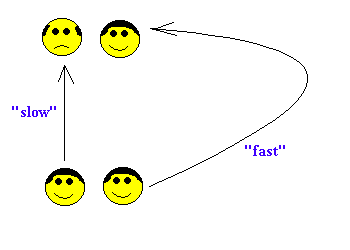
Any functioning time piece I carried with me would show less time elapsed than would be the case for those who just stayed put on campus.  This is clearly not a matter of appearances.  Relativity theory says something deep and counterintuitive about the structure of space and time.  

I was also impressed by the power of careful and clear reasoning.  Such thinking is capable of revealing highly counterintuitive and beautiful truths.  My love was deepening.  I decided I would major in physics.  I was not ready to propose marriage, but I had something good going with my college girlfriend.


Sunday, May 11, 2014

Career Resources at UK's Institute of Physics

The London-based Institute of Physics has a lot of material very much like what we are trying to provide here with our monthly interviews.  Check out both their Once a Physicist collection as well as their Working in Physics collection.  That's not what I would have called either of these categories; I say once a physicist always a physicist and, ahem... I believe I am actually "working in physics."  But there are quite a number of interviews in the first category, and first person narratives in the second, that are quite interesting.  Thanks to Duncan Hanson for pointing me to these IOP articles.

Sunday, May 4, 2014

Innovation and the Value of a Physics Degree

Elon Musk, founder of SpaceX, Tesla Motors and Solarcity, studied physics and economics at the University of Pennsylvania.  Toward the end of this  TED interview, he is asked how he has been able to innovate so successfully.  In his reply he says

I do think there’s a good framework for thinking. It is physics, that sort of first principles reasoning. What I mean by that is, boil things down to their fundamental truths and reason up from there, as opposed to reasoning by analogy. Through most of our life, we get through life by reasoning through analogy, which essentially means kind of copying what other people do with slight variations. And you have to do that, otherwise, mentally, you wouldn’t be able to get through the day. But, when you want to do something new, you have to apply the physics approach. Physics is really sort of figuring out how to discover new things that are counterintuitive, like Quantum Mechanics. It’s really counterintuitive. I think that’s an important thing to do. 
I'd say that's a pretty solid endorsement of the value of a physics education.  If you want to read more from Elon Musk on this subject, see this interview done by the American Physical Society.

Of course this is the experience of just one individual and he's clearly an outlier.  Maybe the value he finds in his physics training is not representative.  So here are some more individuals, all UC Davis alumni, commenting on the value of their training in physics.
Steven Guggenheimer (BS 1987), Chief Evangelist at Microsoft writes, "I realized that the analytical abilities, honed on physics problems at UCD, were exactly what I needed to attack the broad range of business case studies that were part of the graduate curriculum. Across Spectra-Physics, Graduate School and Microsoft, the one common element in all work is problem solving, the most applicable background for problem solving is Physics."
Nelson Pass (BS 1973) founder of Pass Laboratories writes, "Physics was the place to be, and likely still is – the fractal zone between the applied science of something like Engineering and the total abstraction of Mathematics.  I look around at successful people in all sorts of fields and I see that a remarkable number of them have degrees in Physics."

Nancy Roberts (BS 1990), a Materials Engineer with Lockheed Martin Space Systems writes, "The most advantageous take-away was the tenacity, drive, and work ethic to achieve as penetrating an understanding as possible of any material/process/system. "
I believe they are all speaking in different ways to the kind of thinking that they learned as physics students.  This is true of Nancy Roberts as well even though she is explicitly emphasizing "tenacity, drive and work ethic."  She is emphasizing these things because they are often what is necessary to achieve true understanding of a system.  I suspect as a physics student she gained a sense of what it means to truly understand something, and that it is worth fighting to achieve that understanding.  No one said it's easy!  In fact, the first response Elon Musk gave to the interviewer's question was, "I work a lot."  

After hearing from tens of our alumni over the years, I can synthesize some themes that have emerged repeatedly regarding the value of a physics degree.  
1) In many circles, a physics degree leads to instant respect for the intelligence of the degree-holder.
2) Pursuing a physics degree is good practice for tackling a variety of problems – even ones that have nothing to do with physics. 
3) Training in physics helps one to have a systems-level view of an organization, market, or complex product, which allows one to see connections that others miss. 
4) Physicists can find solutions to complex problems, even outside their area of expertise.
As a physics professor I find it immensely gratifying that our students find broad value in their education beyond the more obvious intellectual pleasures of studying, e.g., relativity and quantum mechanics, and pursuing their (perhaps) narrowly-focused research projects. 

Saturday, April 26, 2014

From Physicist or Astronomer to Data Scientist

Data Science is a very rapidly growing field in industry, as companies scramble to get people in place who can pull useful intelligence out of (sometimes) massive amounts of data.  Who are the people with the right skills for this job?  Physicists, of course!  I get that answer from DJ Patil via an Insight Data Science white paper.  The paper quotes the former Chief  Scientist at LinkedIn as saying, “the best data scientists tend to be ‘hard scientists,’ particularly physicists, rather than computer science majors. Physicists have a strong mathematical background, computing skills, and come from a discipline in
which survival depends on getting the most from the data. They have to think about the big picture, the big problem.”

The paper goes on to show a study from the McKinsey Global Institute that reports that the “United States alone faces a shortage of 140,000 to 190,000 people [50 to 60% of supply by 2018] with deep analytical skills” to analyze big data.

So if you are finishing up your physics PhD and considering your options, you may very well be thinking about Data Science.  If you are, you might want to check out these blog posts from physics and astronomy PhDs who have made, or are making the transition.

Here are two brief "how-to" guides:
http://insightdatascience.com/blog/from-phd-to-data-scientist.html
http://womeninastronomy.blogspot.com/2013/01/datascience.html

These two give more personal reflections on the decision:
http://marcelhaas.com/extronomer.html
http://www.craigmbooth.com/farewell-to-astronomy/

This is all on my mind because yesterday (Friday, 4/25/2014) in our alumni seminar series we heard from Guillermo Breto Rangel, now a data scientist, who left Davis with his PhD in experimental heavy ion physics less than a year ago.  Things move fast in this area and he's already moving to a second employer.  In two weeks he is heading off to Princeton to start up a research group at Bloomberg LP. It was also just yesterday I discovered a colleague of mine, Sudeep Das, who did great work analyzing and interpreting cosmic microwave background data from the Atacama Cosmology Telescope, is now a data scientist at Open Table.


Sunday, April 20, 2014

Non-academic Careers and the Invention of Slow-roll Inflation

My friend and colleague Andreas Albrecht used his Facebook page to spread the word about this blog. He included these important remarks at the end:

"Many physics students undertake their studies with dreams of following an academic path. You should not take our efforts to communicate the alternatives as an intent to discourage you. Knowing there are alternatives can in fact be very liberating. That has certainly been the case in my own career. When I was in grad school there were very few faculty opportunities on the horizon. Knowing that there were many options out there allowed me to take risks and choose a research direction that matched my passions with out worrying too much about practicalities."

Feeling at liberty to take risks allowed Andy to pursue work that turned out pretty well, to say the least. Together with his advisor, Paul Steinhardt, they invented slow-roll inflation, a discovery also made independently by Andrei Linde.  This was highly speculative work at the time.  As the data have improved over the past 30+ years it seems to be what nature has chosen to do, which is quite amazing. As many readers undoubtedly know, Andy went on from this graduate work to a highly successful academic career.

If you want to pursue an academic career there is indeed bad news. Your odds of obtaining a tenure-track position at a PhD-granting institution are about 30%.  According to the AIP from 2010-2012 an average of 566 PhDs were granted each year while in 2007-08 only 160 people transitioned into tenure or tenure-track jobs at PhD-granting institutions, also according to the AIP. 

But the good news is that physicists go on to do a variety of interesting things that they find very satisfying, and they generally regard their education as extraordinarily valuable.  As Andy also wrote in his Facebook post, "The creative technical problem solving that we enjoy teaching and applying to the great puzzles of physics is highly valued in diverse careers."